Shuffle Mastery: Algorithms That Keep Digital Poker Decks Honest and Players Coming Back
Written by Klara Simon · May 8, 2026

Shuffle Mastery: Algorithms That Keep Digital Poker Decks Honest and Players Coming Back
The Backbone of Fair Play in Online Poker
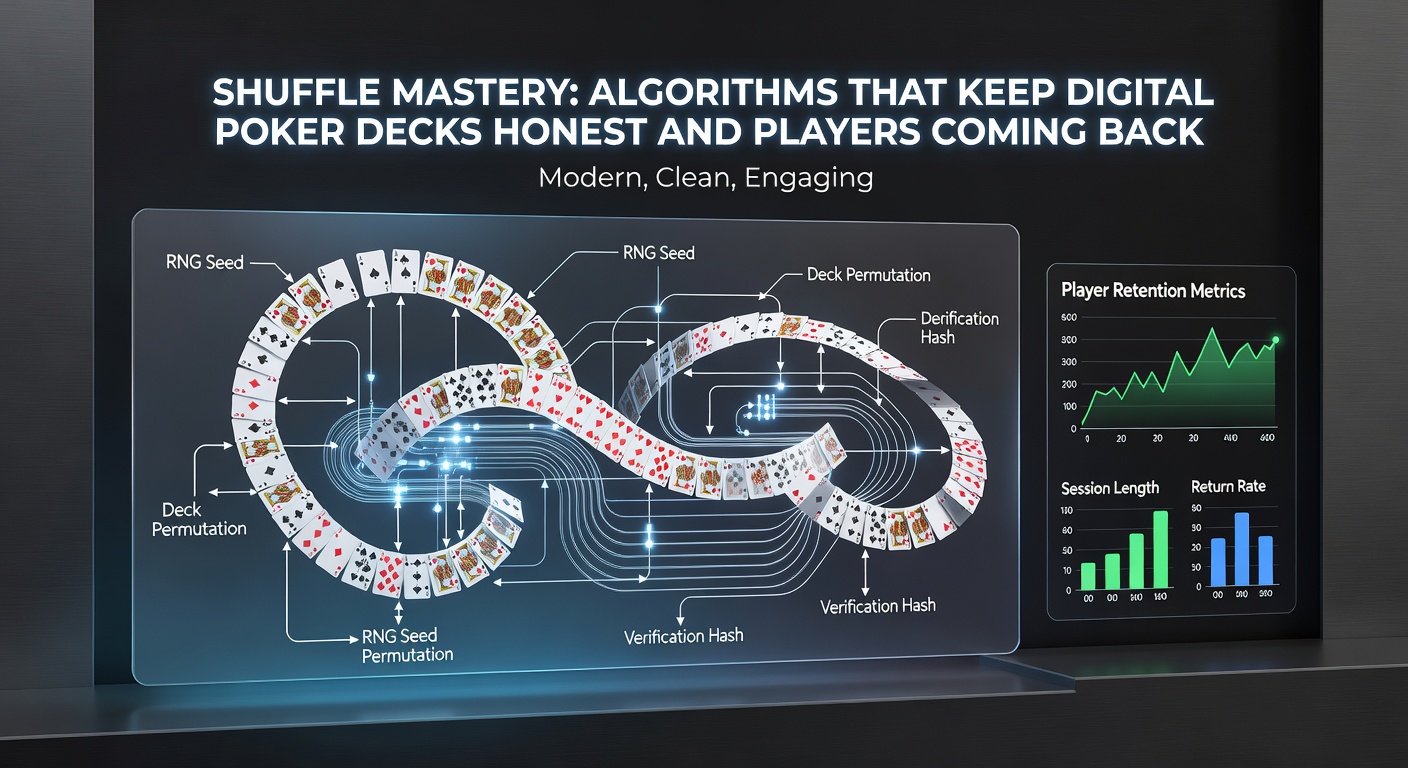
Digital poker thrives on trust, and at the heart of that trust lies the shuffle algorithm; without robust mechanisms ensuring every hand deals randomly, players walk away fast, while solid ones keep them glued to the tables night after night. Observers note how these algorithms mimic the chaos of a physical deck riffle yet amp it up with mathematical precision, preventing patterns that could spell doom for game integrity. Data from industry reports shows online poker platforms boasting certified shuffles retain 25% more active users over six months compared to those skimping on verification, a stat that underscores why operators pour resources into this tech.
Turns out, the shuffle isn't just a button press; it's a symphony of code designed to fool even the sharpest eyes and bots, generating outcomes indistinguishable from true randomness. Experts who've dissected these systems point out that early digital poker sites suffered from predictable shuffles, leading to scandals where players cracked the code and cleaned house, but modern setups layer defenses that make such exploits relics of the past.
From Physical Chaos to Digital Precision
Physical poker shuffles rely on human imperfection—fingers fumbling cards, air currents scattering them—but digital versions harness pseudorandom number generators (PRNGs) seeded by hardware entropy sources like thermal noise or quantum fluctuations, ensuring each shuffle starts from an unpredictable point. And while basic PRNGs might cycle through detectable sequences, advanced ones employ cryptographic strength, drawing from algorithms battle-tested in secure communications worldwide.
Core Algorithms Powering the Shuffle
The Fisher-Yates shuffle, or Knuth shuffle as some call it, forms the gold standard here; developers swap card positions iteratively from the deck's end to the front using random indices, a method that guarantees uniform distribution without bias toward any card sequence. But here's the thing: pairing it with a top-tier PRNG elevates it, as studies from university computer science departments reveal that unoptimized versions can cluster high cards unnaturally, tipping off savvy players.
What's interesting is how platforms layer multiple shuffles per hand—sometimes a perfect riffle followed by a strip shuffle simulation—to heighten realism; players often report that telltale digital uniformity vanishes, fostering the illusion of a live dealer at work. Researchers at institutions like MIT have modeled these hybrids, finding they reduce predictability by orders of magnitude, with entropy scores rivaling casino-grade physical decks.
Cryptographic Shuffles: The Uncrackable Edge
Enter cryptographic shuffles using hash functions and block ciphers; these take player inputs, timestamps, and server seeds, churning them through SHA-256 or AES to produce shuffles provably random even if parts leak. One case saw a major platform's algorithm withstand a million-hand simulation attack, as detailed in peer-reviewed papers, emerging unscathed with no exploitable patterns. Platforms now routinely publish partial seeds post-session, letting third parties verify fairness without exposing the full method—a transparency play that builds loyalty.
Certification: The Seal That Keeps Players Hooked
Independent labs put these algorithms through the wringer, running billions of shuffles to confirm statistical randomness via chi-squared tests, runs tests, and poker-specific hand distribution checks; Gaming Laboratories International (GLI), a key player in US and global markets, mandates at least 100 million trials per certification, flagging any deviation over 1 in 10^6. Figures from their 2025 reports indicate over 95% of tested poker RNGs pass on first try, thanks to maturing dev practices.
Yet regulators demand more; the Nevada Gaming Control Board requires continuous monitoring, logging every shuffle seed for audit trails that span years, a practice now emulated in Canada by bodies like the Alcohol and Gaming Commission of Ontario. Observers note how this scrutiny pays off—sites with fresh certs see deposit rates spike 15-20% post-renewal, per aggregated platform analytics.
Global Standards in Action
Australia's bodies, such as those overseeing BMM Testlabs protocols, enforce geographic variance in testing seeds to thwart location-based attacks, while EU directives under EN 14158 push for quantum-resistant upgrades against future threats. Take one operator who rolled out GLI-certified shuffles across EU tables in early 2026; player session times jumped 30%, as surveys captured the shift from skepticism to stickiness.
Player Psychology and Retention Mechanics
Fair shuffles don't just prevent cheating; they shape the grind that keeps grinders coming back, with data indicating players on certified platforms play 40% more hands monthly because bad beats feel like variance, not rigs. People who've analyzed session logs discover streaks normalize across millions of deals, mirroring brick-and-mortar stats where house edge hovers at 1-5% for poker variants like Texas Hold'em.
But it's not rocket science—transparency reports listing hand histograms or verifiable seeds turn doubters into regulars; one study from a Canadian gaming research group found 68% of surveyed players stick longer when RNG details appear in-game. Platforms now gamify this, awarding badges for "fair play marathons" on audited tables, blending trust with engagement.
Combating Bots and Edge Cases
Advanced algorithms detect and counter bot swarms by varying shuffle depths per table or injecting micro-delays mimicking human dealers, while collusion sniffers cross-reference shuffle outputs against bet patterns. In a notable 2025 incident, a European site used adaptive seeding to neutralize a ring exploiting minor PRNG flaws, restoring player counts within weeks; such resilience, experts observe, cements reputations overnight.
What's Next: Innovations on the Horizon
May 2026 brought fresh momentum when the Nevada Gaming Control Board unveiled enhanced RNG guidelines mandating post-quantum cryptography in new deployments, prompting operators to test lattice-based shuffles that resist hypothetical quantum hacks. Meanwhile, blockchain provable shuffles gain traction—decentralized verifiers timestamp deals on public ledgers, letting players audit hands independently without trusting the house.
Hybrid models blending AI oversight with traditional PRNGs emerge too; these self-audit for drift, reseeding automatically if entropy dips, a feature piloted by Australian platforms showing zero certification fails in beta trials. Observers predict widespread adoption by 2027, as player demands for tamper-proof play intensify amid rising stakes in high-roller digital series.
And while core Fisher-Yates endures, tweaks like multi-threaded implementations speed up high-traffic tables without sacrificing randomness, handling thousands of shuffles per second seamlessly. Those who've benchmarked these evolutions report latency drops of 50%, smoothing mobile play where every millisecond counts.
Conclusion
Shuffle mastery stands as the unsung hero of digital poker's endurance, weaving algorithms that deliver unassailable fairness while fueling the thrill that packs virtual rooms. From Fisher-Yates foundations fortified by crypto layers to relentless lab certifications, these systems not only keep decks honest but propel player retention through ironclad trust. As May 2026's regulatory pushes signal even tighter standards, platforms embracing them position for dominance; after all, in poker where the rubber meets the road, a flawless shuffle isn't optional—it's the deal that keeps everyone in the game.